Finitio 0.4.x
Information Contracts
Finitio tries very hard not to be yet another data language. In particular, it aims at integrating as smoothly as possible with existing technologies, in particular with programming languages and data exchange formats (e.g. JSON or YAML).
This interoperability is handled through so-called information contracts. In some respect, information contracts are the dual of axiomatic contracts, i.e. the dual of public behavioral APIs of software abstractions.
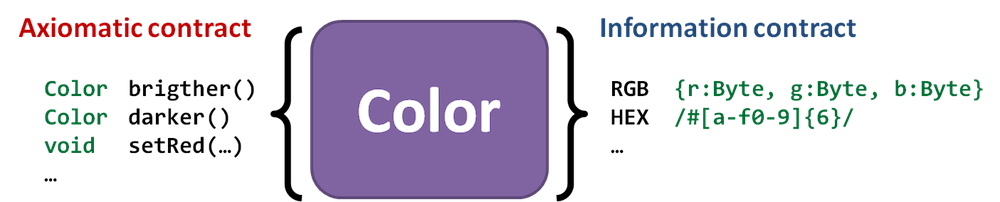
For a given software abstraction, say a Color:
- The axiomatic contract hides the internal representation in favor of a set of public behavioral methods to manipulate the abstraction (e.g. darkening and brightening the color),
- The information contract hides the internal representation in favor of a set of public information representations of the abstraction (e.g. a RGB triple, an hexadecimal string).
The data types involved in the definitions of the information contracts are
called information types, e.g. {r: Byte, g: Byte, b: Byte} (a tuple type).
Finitio provides a rich type system
dedicated at capturing those data types precisely, mostly because type systems
of mainstream programming languages fail at providing good support for them.
Dressing & Undressing
In a more precise way, an information contract is actually a set of function pairs, such as:
# RGB information contract
dress   :: {r: Byte, g:Byte, b: Byte} -> Color
undress :: Color -> {r: Byte, g:Byte, b: Byte}

# HEX information contract
dress   :: String( s | ... ) -> Color
undress :: Color -> String( s | ... )
In other words, each public data representation of an abstraction comes with two (pure) functions that allow dressing the corresponding information type with the abstraction behavior, and undressing the latter the other way round.
Validating is not dressing
The two are easy to confuse, and both implementations expose them separately.
- Validating asks whether a value already belongs to a type. It is a question about set membership, and nothing is converted.
- Dressing converts an exchange-level document into host values. A
document may well fail validation and still dress successfully — that is
the entire point of a contract. The string
"2014-07-17"is not aDate; it is the ISO 8601 representation of one, and dressing is what turns it into a real date. - Undressing goes the other way, producing something you can serialise again.
Declaring an abstract data type
A type can list its representations, each introduced by a name in angle brackets:
Color = <rgb> {r: Byte, g: Byte, b: Byte},
        <hex> String( s | /^#[0-9a-f]{6}$/i.test(s) )
Defined like that, Color behaves as a union type: it lets valid RGB triples
and hexadecimal strings pass, unchanged.
Binding to the host language
Representations become contracts once they are connected to an abstraction of the host language. The type then starts with a builtin type naming that abstraction, and each representation may carry its dress and undress functions, written with a leading backslash:
Color = .Color
  <rgb> [Integer] \( triple | Color.rgb(triple) )
                  \( color  | color.toRgb()     )
  <hex> String    \( hex    | Color.hex(hex)    )
                  \( color  | color.toHex()     )
Dressing [12, 13, 14] against that type now yields an actual Color
instance rather than an array.
The functions are host-language code, so this part of a schema is inherently
implementation-specific — the example above is JavaScript, and the Ruby
equivalent would call Color.rgb(triple) and color.to_rgb.
Conventions instead of explicit functions
Both implementations can infer the two functions from naming conventions, so the explicit form is often unnecessary:
Color = .Color
  <rgb> [Integer]
  <hex> String
Here rgb dresses through Color.rgb(...) and undresses through
color.toRgb() in JavaScript (color.to_rgb in Ruby). The standard
library's Date is defined exactly this way.
Choosing what to undress to
Dressing picks a representation by trying them in order. Undressing has to be
told which one to target, since an abstraction usually has several. A schema
does that by naming a type built from a specific contract, with
Type/contract:
Color = .Color
  <rgb> [Integer]
  <hex> String

Output = [Color/hex]

[Color]
Reading that: the main type dresses a sequence of colors from whatever
representation each one uses, and Output describes the form to undress them
back into — hexadecimal strings.
Contracts in action
Dressing and undressing generally apply recursively, e.g. when involving collection and abstract data types. This provides the real ability of Finitio to dress and undress complex data involving many information contracts and many abstractions.
Consider the following Finitio system, for dressing sequences of tuples having a name attribute restricted to simple words:
@import finitio/data

Word = String( s | /^[a-z]+$/.test(s) )

[{ name: Word }]
Dressing a JSON document involves a chain of contracts:
- Dressing a JSON string into a host string (by the JSON parser)
- Dressing that string into a
Word(by Finitio) - Dressing a host hash/object into a tuple (by Finitio)
- Dressing a host array into a sequence (by Finitio)
The concrete dressing result is implementation-dependent, as it involves the
definition of the representation function Rep that binds Finitio types to
types in the host language. The aim is not to define new host abstractions,
e.g. classes, for every Finitio type defined in a system but rather to check
that values conform to Finitio types and choose an idiomatic
representation in the host language. However, all those information contracts
are actually involved in the dressing process and provide as many places to
validate and coerce data in practice.
Data interoperability
According to the host programming language, the interoperability with exchange formats such as JSON is more or less complete. In Ruby, for instance, the interoperability is already pretty good, and can be explained as follows:
RbBoolean = <json> JSBoolean
RbString  = <json> JSString
RbNumeric = <json> JSNumber
RbHash    = <json> JSObject
RbArray   = <json> JSArray
Such a mechanism is already built into the Ruby standard library, and explains why working with JSON data is rather natural in Ruby. Among others, this allows Finitio-rb to be kept simple, and work with the Ruby type system only, delegating the interoperability with JSON to the usual parsing library.
Observe, however, that this interoperability is straightforward but actually
biased towards JSON. The developer has no way of stating that some value must
be a Ruby Integer, since the JSON specification does not distinguish
integers from reals. One aim with Finitio is to give developers a way to fix
this, by specifying more specific information contracts and having full
control of them — which is also why Integer and Real are the two standard
library types whose behaviour differs most between bindings. See
numbers need care.
You can watch all of this happen, step by step, on the playground: every example reports validating, dressing and undressing separately.